
A white button-down shirt, black pants, a kippah, long wigs, a tennis racket and lots of joy on the court. A groundbreaking project opens the door to the world of competitive sports for ultra-Orthodox children – without asking them to change their lifestyle. Will the next Uncle Sela come from Talmud Torah?
Amid the turmoil of the draft law and the wall that stands between the secular and ultra-Orthodox public, there are also places where harmony prevails between the two camps. This won’t fix the country, but it gives a small glimmer of hope for connections that can, through sports, sow a little sanity in the civil war that is unfortunately emerging here.
Our story begins with 36-year-old Bezio Osun, who was a talented defender in all of Maccabi Haifa’s youth teams, alongside names like Shlomi Azoulay, Eyal Golsa, Taleb Tuatja and Muhammad Gadir. “The time in Haifa,” he says, “taught me that no matter how different the backgrounds are between you and the other players on the team, you can be friends and family, with great love and mutual respect.”
Shortly before breaking into the senior team, Osun decided to begin a process of repentance, which led him to abandon his dream of wearing green and move down to League One, where games are not played on Shabbat, with teams like Kfar Kasem, Shikun HaMizrahi and Marmorek. After completing a bachelor’s degree in psychology and a master’s degree in public policy, and serving in sports management positions in several local councils, Osun founded the “Goal on God” association, which operates with the support of the Azrieli Israel Foundation’s SSI program, which aims to combine sports with Jewish values.
“Each time I took a different verse from the weekly Torah and turned it into a slogan for the kids who train with me, with an explanation of how that verse connects to their world on the field,” he says. “In one case, we took the verse ‘Vaidum Aharon’ and did an entire practice in silence. Simply without uttering a word. The teachers of the students at that school asked me where I got that brilliance.”
The barrier was broken.
The “Goal for God” association began operating in 2024 in educational institutions, with 40 sports teams that include ongoing activities and special projects, in which approximately 800 children participate.
One of the ideas was to make tennis accessible to the ultra-Orthodox sector – a tall mountain to climb, considering that the director of the tennis center, Danny Mizrahi, admits that he tried in every possible way to break the barrier with the ultra-Orthodox sector, after having succeeded in establishing collaborations with every other sector.
“Tennis is seen as an elitist game,” says Mizrahi. “But we have projects here with at-risk boys and girls, and we’ve managed to make the game accessible to almost everyone who has tasted it once and stayed with us. In terms of the ultra-Orthodox sector, we simply haven’t found the formula.”
The formula was brought by Osun, who notes: “We arrived very attentive and inclusive, with a genuine desire to provide the Torah Talmud with which we spoke with all the conditions that Haredi children need to begin practicing.”
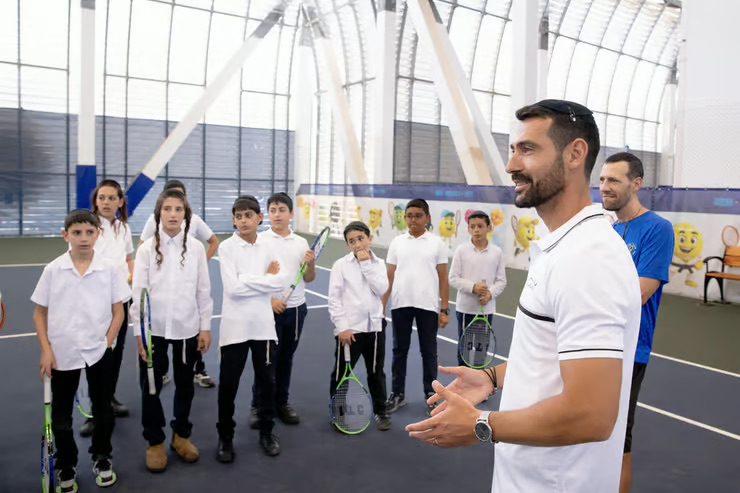
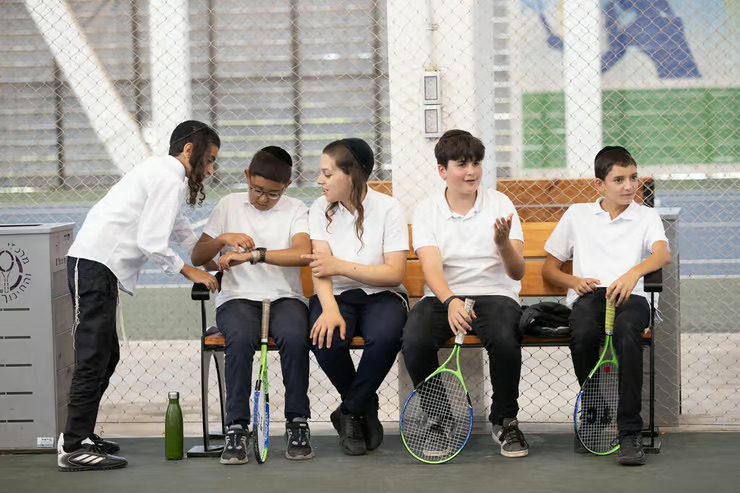
For this to happen, Osun faced a demanding list of demands from the Torah Talmud “For My Brother – T”T Sha’arei Torah from the Mekor Baruch neighborhood in Jerusalem. Pay attention to the list of requests: The children come in their home uniforms – that is, a white button-down shirt and black pants – and forgo wearing tennis uniforms. The court where they practice is covered and isolated from any other court to avoid exposure to girls, inappropriate language, or anything that has a hint of immodesty.
In addition, there is a commitment that throughout the training process, apart from the professional aspect, an emphasis will be placed on values, respect and politeness, and that the coach, despite not being a Torah and mitzvot observer, will make the children, seventh grade students, feel as if they have stepped into a room in their own Torah Talmud.
“There was concern on the part of the parents and the educational institution that tennis would spoil the children, cause them to meet people from the secular sector and expose them to things that, for them, were strictly forbidden,” emphasizes Osun. “We made it clear in advance that we only wanted to prove that it was possible to play sports and continue to be observant of Torah and mitzvot, and that overall we wanted to give them a basket of tools for a healthy lifestyle. To show that it was possible to both study Torah and play sports.”
At the last practice of the season, with medals being awarded to all participants, it was spectacular to see the 27 little ones enjoying every moment with the racket. The children, with black caps and long wigs, are playing tennis as if they are already professionals in the field. Each of them wanted to say: “Tennis is the most fun thing for us, and we are just waiting for the practice to end so that the next practice can begin. We love winning, but we love the game more, the competition and the improvement that we see among us, after all, until a few months ago we didn’t even know such a sport existed.”
The tennis project recently received the Azrieli Prize for this unique collaboration. The rabbi of Talmud HaTorah with whom the project is being run, Rabbi Ephraim Resnik – who served in the IDF and knows a thing or two about integrating into society – is very pleased with the fact that it is possible to connect the two worlds – the secular and the ultra-Orthodox – in such a natural way.
“We are open to any cooperation, as long as all our conditions are met,” explains Rabbi Resnik. “Once they accepted all our conditions that the children would not be exposed to negative things, we saw no problem. We are happy that the children are enjoying themselves and experiencing something new. Moreover, at this age they are very lively, and this can help them. There are several important components here: sports and values, through the connection of spirit and matter. We made the principles of the project accessible to the children’s parents, and everyone is satisfied.
“I hope there are those who understand that these connections can be maintained in all areas of life, not just in tennis for 13-year-olds. It all depends on willingness, acceptance, flexibility, and coordination of expectations. Neither we nor whoever initiated this project will change the world and the divisions in Israeli society, but from our small place we can prove that there is another way, in which we may remember that we can live together, work together, and play together, without each side trying to bend the other side’s hands because of interests.”